The French Revolution, 1789-1799 by McPhee Peter
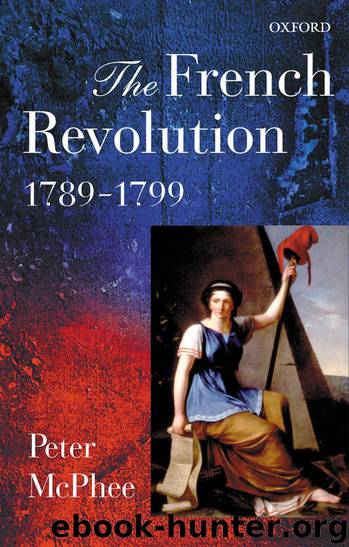
Author:McPhee, Peter [McPhee, Peter]
Language: eng
Format: mobi, epub
Tags: Politics, History, 18th Century, France
Published: 2002-03-06T19:12:19+00:00
THE TERROR
700 new titles were produced across the revolutionary decade, with 41
per cent of them in 1793–4. In the first half of 1794, five issues of
‘Collections of Heroic and Civic Acts of French Republicans’, the third in 150,000 copies, were sent to schools to replace catechisms. However, the Jacobins never had the time or money to implement their education policy, let alone to train lay teachers to replace priests, and few children attended school during the Terror. In the city of Clermont-Ferrand, for example, only 128 pupils attended school from a population of 20,000 people.
The imperatives of reason and regeneration impelled the Convention to accept proposals for sweeping reform of the systems of measuring weight, distance, and volume. Previous systems were condemned as both bewilderingly irrational and tainted by their origins in the mists of ancien régime time. A uniform, decimal system of weights and measures, announced the Convention on 1 August 1793, would be
‘one of the greatest benefits that it can offer to all French citizens’. The
‘artists’ of the Academy of Science would be responsible for the design and exactitude of the measures, while ‘Instructions on the new measurements and their relationship to the most widely used old ones will be inserted into elementary arithmetic textbooks which will be created for national schools.’2 The new measures would be more successful than the Republic’s primary schools.
The Constitution of 1793 had made an unprecedented commitment to social rights and the Convention took several measures to extend the rights of children: on 4 July 1793 abandoned children became a state responsibility and on 2 November 1793 children born outside marriage were guaranteed full inheritance rights. As with education policy, Jacobin commitment to eradicating poverty foundered because of the financial demands of the war and lack of time. Saint-Just’s draft laws of February–March 1794, which were to use ‘suspects’’
property to ‘indemnify the poor’, and the national programme of social welfare announced on 11 May 1794, were only spasmodically implemented.
During the eighteen months from the overthrow of the monarchy in August 1792 until early 1794, a combination of radical Jacobin reforms such as these and popular initiative created an extraordinary force for republican ‘regeneration’. This was one of those rare periods in history when huge numbers of people acted as if they had remade THE TERROR
|
133
the world, a time of ‘cultural revolution’. Its inspiration came from images of the virtues of ancient Greece and Rome, in which middle-class Jacobins had been schooled, and from the practice of huge numbers of working people in town and country living through a radical revolution which was under siege. Jacobin policy and popular action coincided through official and spontaneous use of festivals, plays, songs, broadsheets, decoration, clothing, and leisure. There was often, however, a tension between popular symbolic enaction of total change––the physical destruction of religious statuary, paintings, and other signs of the ancien régime––and Jacobin concern for what Grégoire called ‘vandalism’, leading to protective laws in September 1792. This coincided with the creation of departmental and national public libraries, archives and museums late in 1793.
Download
The French Revolution, 1789-1799 by McPhee Peter.epub
This site does not store any files on its server. We only index and link to content provided by other sites. Please contact the content providers to delete copyright contents if any and email us, we'll remove relevant links or contents immediately.
| Africa | Americas |
| Arctic & Antarctica | Asia |
| Australia & Oceania | Europe |
| Middle East | Russia |
| United States | World |
| Ancient Civilizations | Military |
| Historical Study & Educational Resources |
Room 212 by Kate Stewart(5120)
The Crown by Robert Lacey(4814)
Endurance: Shackleton's Incredible Voyage by Alfred Lansing(4782)
The Iron Duke by The Iron Duke(4354)
The Rape of Nanking by Iris Chang(4213)
Joan of Arc by Mary Gordon(4110)
Killing England by Bill O'Reilly(4001)
Say Nothing by Patrick Radden Keefe(3985)
I'll Give You the Sun by Jandy Nelson(3447)
Shadow of Night by Deborah Harkness(3368)
Hitler's Monsters by Eric Kurlander(3342)
Mary, Queen of Scots, and the Murder of Lord Darnley by Alison Weir(3210)
Blood and Sand by Alex Von Tunzelmann(3203)
Eleanor & Park by Rainbow Rowell(3173)
Darkest Hour by Anthony McCarten(3133)
Margaret Thatcher: The Autobiography by Thatcher Margaret(3082)
Book of Life by Deborah Harkness(2939)
Red Famine: Stalin's War on Ukraine by Anne Applebaum(2934)
The One Memory of Flora Banks by Emily Barr(2863)
